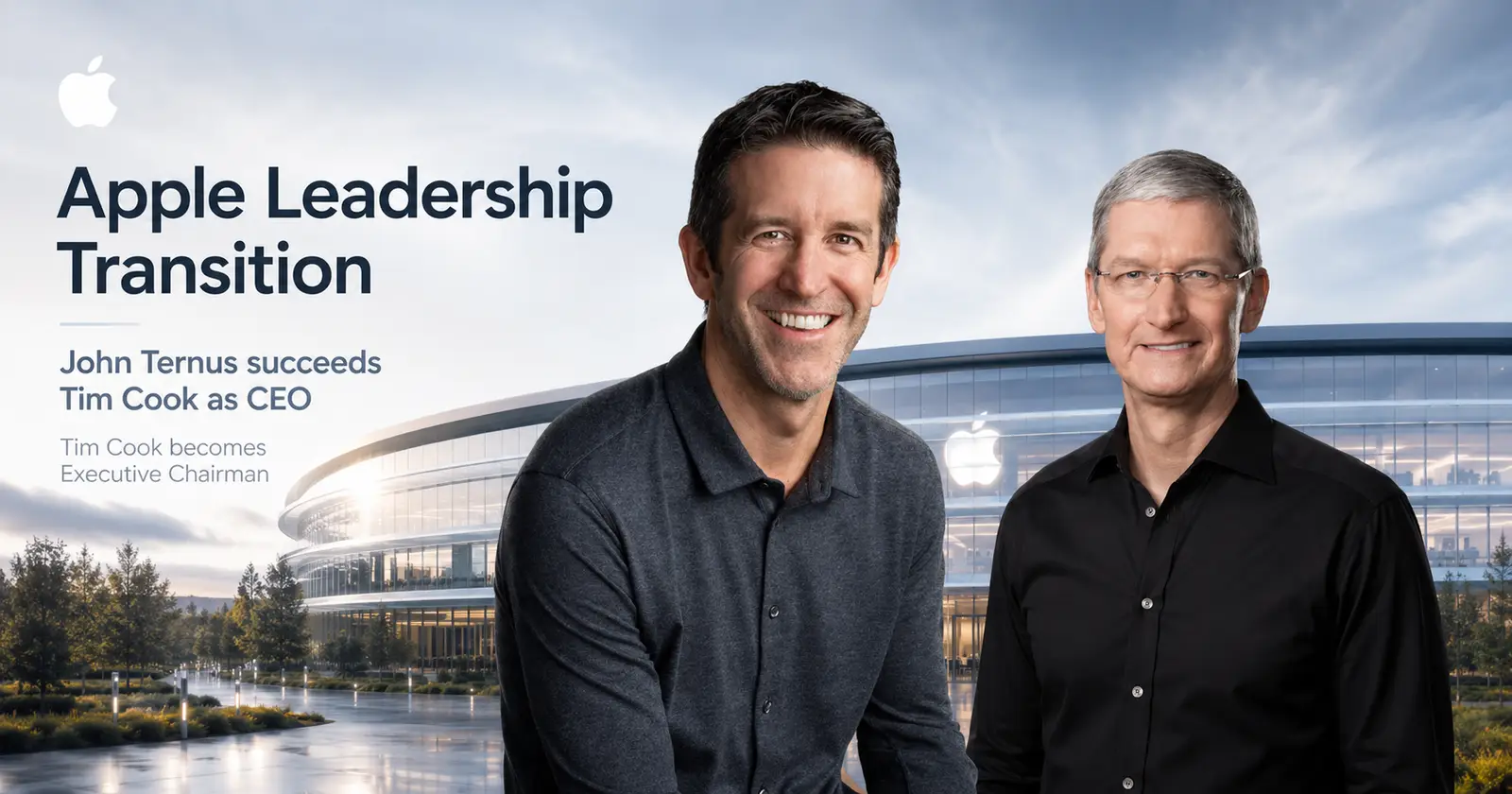
Tim Cook stepped down as Apple's CEO on September 1, 2026, after 15 years in the role, moving into a new position as Executive Chairman of Apple's board. He's succeeded by John Ternus, Apple's hardware engineering chief since 2021 and a 25-year company veteran. Under Cook, Apple's market value grew from about $350 billion to well over $4 trillion, though he also faced real criticism over labor practices, App Store antitrust fights, and a slow start on AI. This guide covers both men's full Apple careers, what changed at the company under Cook, why Ternus got the job, and the questions people are actually asking about the switch.
Apple has changed CEOs exactly once in its history as the company we know today, when Steve Jobs handed the job to Tim Cook in August 2011. That happened again on September 1, 2026. Cook, who ran Apple for 15 years and helped turn it into the most valuable company most people have ever seen, moved into a new role as Executive Chairman. John Ternus, the engineer who has quietly run Apple's hardware operation since 2021, is now CEO.
This is a genuinely big story in tech, not just because of who's involved, but because of how rarely it happens. Apple has had exactly three CEOs since 1997. This guide covers the full picture: what actually happened and when, who Tim Cook is and what he built, who John Ternus is and why he got the job, and the specific questions people are searching for about both men.
What Happened: Tim Cook's Apple CEO Transition, Explained
Apple announced the change on April 20, 2026. In an official statement, the company said Tim Cook would become Executive Chairman of Apple's board of directors, while John Ternus, senior vice president of Hardware Engineering, would become CEO, both effective September 1, 2026. The board approved the plan unanimously after what Apple described as a long-term succession planning process, and Cook stayed on as CEO through the summer to help manage a smooth handoff.
The language from both men was warm and specific. Cook said Ternus "has the mind of an engineer, the soul of an innovator, and the heart to lead with integrity and with honor." Ternus responded: "I am profoundly grateful for this opportunity to carry Apple's mission forward. Having spent almost my entire career at Apple, I have been lucky to have worked under Steve Jobs and to have had Tim Cook as my mentor." Board chair Arthur Levinson, who had held that role for the prior 15 years, called Cook's leadership "unprecedented" and said the board believed Ternus was "the best possible leader to succeed Tim." Levinson himself shifted to lead independent director on the same date Ternus joined the board.
Cook later explained his timing in an interview with Fox Business, saying it came down to three things lining up: "I looked at the performance of the company in the first half, and it's been remarkable. I wanted to announce at a point in time where our roadmap was incredible, and so there would be some great things happening in the future." The third factor, he said, was that Ternus was ready.
Apple's stock dipped about 2.5% the day after the announcement, then recovered within a single trading session. Analysts broadly described the market's reaction as muted, since Ternus had been the presumed frontrunner in succession reporting for well over a year before the news became official.
Did Tim Cook Retire From Apple?
No, Tim Cook did not retire. He stepped down as CEO but remains at Apple as Executive Chairman of the board, a role that keeps him actively involved in the company rather than leaving it.
Apple has said Cook will "assist with certain aspects of the company, including engaging with policymakers around the world." That's already playing out. In May 2026, Cook joined a delegation of US CEOs, including Elon Musk and Larry Fink, on a trip organized around a summit between President Trump and Chinese President Xi Jinping covering trade, AI, export controls, and other geopolitical issues. Cook built this kind of policy relationship-management role during Trump's first term too, when he worked to secure tariff exemptions for Apple and helped shift more US-bound iPhone production toward India. As Executive Chairman, that diplomatic function looks set to continue, just without the day-to-day operating responsibilities of running the company.
Who Is Tim Cook? His Journey to Apple's Top Job
Timothy Donald Cook was born November 1, 1960, in Mobile, Alabama, and raised in nearby Robertsdale, where he graduated salutatorian from Robertsdale High School in 1978. He's the middle of three sons born to a shipyard worker and a homemaker. He earned a bachelor's degree in industrial engineering from Auburn University in 1982, followed by an MBA from Duke University's Fuqua School of Business.
Cook's career before Apple was entirely about supply chains and operations, not products. He spent 12 years at IBM, rising to Director of North American Fulfillment, then worked as COO of the reseller division at Intelligent Electronics, then spent a brief six-month stint at Compaq as Vice President of Corporate Materials before Steve Jobs personally recruited him.
Cook joined Apple in March 1998 as Senior Vice President of Worldwide Operations, during a period when the company was close to running out of money. He'd reportedly turned down Apple recruiters more than once before a conversation with Jobs, centered on what became the iMac, convinced him. What he built at Apple over the next several years is one of the most underrated stories in the company's history: he closed factories and warehouses, shifted manufacturing to contract partners like Foxconn, and cut Apple's inventory cycle from months down to days. That operational discipline is widely credited as the foundation Apple's later growth was built on.
He became Chief Operating Officer on October 14, 2005, after serving as EVP of Worldwide Sales and Operations. He also ran the company as acting CEO during two of Steve Jobs's medical leaves, in 2009 during a six-month leave for a liver transplant, and again from January to August 2011. Jobs formally resigned as CEO on August 24, 2011, writing in his resignation letter that he'd always said he would be the first to let the board know if he could no longer meet his duties, and recommending the board name Cook as his successor. Cook became CEO that same day. Jobs stayed on as Chairman.
Tim Cook's Biggest Achievements as Apple CEO
Cook's 15 years as CEO produced a genuinely long list of new products and business moves, several of which reshaped how Apple makes money.
New product categories launched under Cook:
- Apple Watch (2015)
- AirPods (2016)
- HomePod (2018)
- AirTag (2021)
- Apple Vision Pro (2024)
- Apple's first foldable iPhone, expected to debut at the company's September 9, 2026 event
The Apple Silicon transition. Announced at WWDC on June 22, 2020, Cook called it "a historic day for the Mac." Apple moved its entire Mac lineup off Intel chips and onto its own custom silicon over a two-year plan. The first M1 Macs shipped in November 2020, and within five months, M1 Mac sales had already overtaken Intel Mac sales.
Apple's first dividend in 17 years. In March 2012, Cook announced Apple would pay a quarterly dividend for the first time since 1995, alongside an initial $10 billion stock buyback program. At the time, Apple was sitting on $97.6 billion in cash. That buyback program later grew into the largest in corporate history.
Services became a real business. What used to be a side feature of the iPhone is now one of Apple's most profitable divisions. Services revenue hit record highs repeatedly through 2025 and 2026, including roughly $30 billion or more in multiple recent quarters, and by early 2026 services accounted for nearly 43 cents of every dollar of Apple's gross profit. Apple also reported passing 1.5 billion paid subscriptions across iCloud and App Store subscriptions combined.
Environmental commitments. Apple's own operations became carbon neutral in 2020, and the company committed in July 2020 to making its entire supply chain and product life cycle carbon neutral by 2030. By 2024, Apple said it had cut its combined emissions by more than 60% against a 2015 baseline, with over 300 suppliers committed to clean energy for Apple production.
Retail growth. Apple's retail footprint grew from roughly 400 stores in 2013 to more than 500 stores across 26 countries in recent reporting.
How Many Products Did Tim Cook's Apple Release?
Apple released more than 45 iPhone models across 16 major generations during Cook's tenure, alongside dozens of iPad, Mac, Apple Watch, and AirPods releases.
Breaking that down by category: iPhone releases ran from the iPhone 4s in 2011 through the iPhone 18 series expected in September 2026, typically on an annual cycle. iPad releases were even more frequent, with Apple shipping around 45 distinct iPad models (across the standard iPad, iPad Air, iPad mini, and iPad Pro lines) by mid-2026. AirPods launched in 2016 and grew into four generations of the standard model, three generations of AirPods Pro, and a second-generation AirPods Max released in April 2026. Apple Watch has released a new generation nearly every year since 2015. On the Mac side, Apple has shipped 25 different Apple Silicon-powered laptop models alone since the 2020 chip transition, on top of every Intel-era Mac that came before it.
That product output scaled alongside the company itself. Apple's headcount grew from about 60,400 employees in fiscal 2011 to roughly 171,000 by early 2026, more than doubling. Beyond direct employees, Apple has said its supplier network supports around 450,000 additional jobs.
Apple's Value: What Changed From 2011 to 2026
This is the number that tends to surprise people most. When Tim Cook became CEO in August 2011, Apple was worth just under $350 billion. By late July 2026, Apple had crossed $5 trillion in market value for the first time, having already passed $4 trillion earlier in the year. That's roughly a fourteen-fold increase over 15 years.
Along the way, Apple hit milestones no company had reached before it:
- $1 trillion, reached intraday on August 2, 2018, making Apple the first US public company to get there.
- $2 trillion, reached August 19, 2020, again a first for a US company.
- $3 trillion, which involves a small wrinkle worth explaining precisely: Apple briefly touched $3 trillion intraday on January 3, 2022, before falling back below that level. It then closed above $3 trillion for the first time on June 30, 2023, which most retrospectives treat as the more meaningful milestone since it reflected a sustained valuation rather than a brief spike.
- $5 trillion, reached in late July 2026, shortly before Cook's transition to Executive Chairman took effect.
Revenue tells a similar story. Apple's annual revenue is reported to have roughly quadrupled under Cook, from about $108 billion in fiscal 2011 to approximately $416 billion in fiscal 2025.
The Challenges Tim Cook Faced as CEO
None of that growth happened without real friction, and a fair account of Cook's tenure has to include the fights, scandals, and criticism alongside the wins.
Foxconn labor conditions (2010-2012). A wave of worker suicides was reported at Foxconn's Shenzhen facilities starting in 2010, with figures varying by source but generally cited around 14 to 18 incidents over roughly a year, prompting Foxconn's controversial decision to install anti-suicide nets around its buildings. A 2011 explosion at Foxconn's Chengdu plant, built in just 76 days, killed four workers and injured eighteen, reportedly linked to a known but ignored combustible-dust hazard. Apple commissioned the Fair Labor Association to audit three Foxconn plants in 2012, which found "serious and pressing noncompliances," particularly around forced and excessive overtime. Foxconn agreed to cap the legal workweek at 49 hours and cut monthly overtime from 80 to 36 hours, though labor advocates like the Economic Policy Institute argued the FLA gave the companies too much credit for only partial follow-through.
The "Apple doesn't innovate anymore" narrative. This criticism followed Cook for most of his tenure. One frequently cited stat: Apple's revenue growth averaged just 2.3% over a recent three-year stretch, compared to double-digit growth at Alphabet, Amazon, Meta, and Microsoft, 24% at Tesla, and 80% at Nvidia. A former Apple engineer told PhoneArena that Cook turned the company "from a dynamic change-maker into a boring operations company." By summer 2025, at least one major Wall Street firm had reportedly called for dramatic change at Apple, including Cook's departure, largely over the AI concerns below.
The Epic Games lawsuit. In September 2021, a federal judge ruled largely in Apple's favor on antitrust grounds but found that Apple's policy banning developers from linking to outside payment options violated California's Unfair Competition Law. Apple's attempts to charge a reduced 27% commission on those outside payments (down from the standard 30%) kept the fight going for years. The Ninth Circuit upheld the original ruling in December 2025, and in 2026 a court held Apple in contempt for continued non-compliance; the US Supreme Court declined to pause that contempt order in May 2026.
EU regulatory pressure. The European Commission fined Apple €500 million in April 2025 for violating the Digital Markets Act's anti-steering rules. Apple challenged its "gatekeeper" status under the law but lost that fight at the EU General Court in July 2026. In August 2026, Apple settled with the Commission, replacing its controversial per-install fee structure with a flat 5% commission on eligible external digital sales, effective October 2026.
Right-to-repair. Apple long resisted third-party and self-repair, then reversed course, launching a Self Service Repair program in April 2022 with roughly 200 parts and tools available for iPhone battery and display repairs. Analysts generally read this less as a change of heart and more as a preemptive move to get ahead of state and federal right-to-repair legislation.
The US-China trade war. Tariffs under the Trump administration's second term hit Apple directly, with Cook citing an extra $900 million in costs in one 2025 quarter and projecting over $1 billion the following quarter. Apple responded partly by pledging $500 billion in US investment over four years in February 2025, later increased to a $600 billion total commitment by August 2025, covering new manufacturing, a Houston server facility, and 20,000 new US jobs.
COVID-19 supply chain disruption. Apple's Foxconn-run factories in Shenzhen and Zhengzhou were forced to shut down in the first half of 2020 amid Chinese lockdowns, accelerating a broader shift of manufacturing toward India and Vietnam that continued for years afterward.
The cancelled Apple Car. Apple's decade-long, multi-billion-dollar autonomous vehicle project, known internally as Project Titan, was cancelled in February 2024. Many of the roughly 2,000 employees who'd worked on it were reassigned to Apple's AI efforts.
Vision Pro's rocky reception. Apple's $3,500 headset launched in 2024 and sold an estimated 400,000 to 450,000 units that year, well below internal targets. Cook himself acknowledged it wasn't a mass-market product yet, describing it as built for "early adopters." Reporting through early 2026 continued to describe the device as struggling to catch on with a broader audience.
Falling behind on AI. This is probably the single biggest criticism of Cook's final years as CEO. Apple repeatedly delayed a major AI-powered overhaul of Siri, pushing it into 2026, while competitors moved faster and more visibly: OpenAI's consumer-facing tools, Google's Gemini integration across Android, and Microsoft's Copilot rollout all outpaced Apple's public AI progress. Reports surfaced that Apple was turning to Google's Gemini technology to help power future Siri features, widely read as an acknowledgment that Apple needed outside help. One CNBC piece in December 2025 summed up the mood by calling 2025 the year Apple "punted on AI."
Congressional scrutiny. Cook testified before the US House Judiciary Antitrust Subcommittee on July 29, 2020, alongside the CEOs of Google, Amazon, and Facebook, defending Apple's App Store fee structure and denying the company held a dominant market share in any market it competed in.
Tim Cook's Personal Story: Coming Out, Philanthropy, and Net Worth
On October 30, 2014, Cook publicly came out as gay in an essay for Bloomberg Businessweek, becoming, by most accounts, the first sitting Fortune 500 CEO to do so. He wrote: "I'm proud to be gay, and I consider being gay among the greatest gifts God has given me." He explained his reasoning plainly: if it helped even one person struggling with their own identity, it was worth trading away some of his privacy.
In March 2015, Cook told Fortune he intended to give away the vast majority of his fortune, then estimated around $800 million, during his lifetime, after first funding his young nephew's college education. That announcement is widely described in media coverage as Cook "joining the Giving Pledge," the Warren Buffett and Bill Gates-founded initiative. Worth noting precisely, though: Cook does not appear on the official Giving Pledge signatory list published at givingpledge.org. It's more accurate to describe his 2015 commitment as a pledge made in the spirit of that initiative rather than formal membership in it, since the public record doesn't confirm he ever officially signed on.
Cook's personal wealth grew substantially over his tenure, though not from his base salary, which was set at $3 million a year and stayed flat for years. Most of his fortune comes from stock compensation, including a landmark 2011 restricted stock grant worth roughly $376 to $378 million at the time, which made him the best-paid CEO in the country that year. He officially became a billionaire in August 2020, according to the Bloomberg Billionaires Index, after a large performance stock grant vested around the same time Apple was approaching a $2 trillion valuation. By December 2025, Forbes estimated his net worth at about $2.6 billion, and by spring 2026 that estimate had risen to roughly $2.9 billion, ranking him around #1,504 on Forbes' global billionaires list. Other trackers put the figure somewhat lower, closer to $2.2 billion, which is a reminder that these estimates vary depending on how each outlet values unvested equity and other holdings.
Who Is John Ternus? Meet Apple's New CEO
John Ternus was born in May 1975, making him around 50 or 51 at the time he became CEO. He earned a Bachelor of Science in Engineering, majoring in mechanical engineering and applied mechanics with a minor in psychology, from the University of Pennsylvania, graduating in 1997. That's worth clarifying directly, since it gets misreported online: he did not attend Vanderbilt, and no source documents a graduate degree beyond his Penn bachelor's. At Penn, he swam varsity for the men's swimming and diving team, and his senior engineering project was a mechanical feeding arm designed for people with quadriplegia, controllable through head movements.
After graduating, Ternus spent about four years as a mechanical engineer at Virtual Research Systems, a maker of VR headsets and immersive displays, before joining Apple in July 2001. Apple, by his own account at a 2024 Penn commencement address, was only his second job out of college.
His climb inside Apple took nearly two decades. He started on the Product Design team, reportedly working on the Apple Cinema Display and other Mac display hardware. He moved into a management role a few years in, leading hardware engineering work on iMac projects around 2005 and gaining deep experience with Apple's manufacturing partners in Asia. He was promoted to Vice President of Hardware Engineering in 2013, taking responsibility for Mac and iPad engineering, and is widely credited as one of the key figures behind every generation of the iPad. He was also a key leader during Apple's Mac transition to its own custom silicon chips, and around 2020 took on additional responsibility for iPhone hardware engineering.
In January 2021, Ternus was promoted to Senior Vice President of Hardware Engineering, Apple's top hardware role, succeeding Dan Riccio and reporting directly to Tim Cook. From that point, he oversaw hardware engineering across Apple's entire product lineup: iPhone, iPad, Mac, Apple Watch, AirPods, and eventually Vision Pro. In the years leading up to his CEO appointment, his responsibilities kept expanding, reportedly picking up oversight of Apple's robotics work in 2025 and its Industrial Design team in early 2026, both read at the time as signs he was consolidating influence ahead of the leadership change.
What Values Has John Ternus Brought to Apple?
Apple's own transition announcement credits Ternus with leadership on the iPad and AirPods across every generation, new iPhone, Mac, and Apple Watch hardware, the MacBook Neo, the iPhone 17 lineup, and sustainability efforts including recycled materials and 3D-printed titanium components.
Beyond the product credits, Ternus built a reputation inside Apple as an unusually hands-on, technically fluent executive. Former colleagues have described him as someone who keeps technical minutiae, like plastic material specifications or drop-test physics, at his fingertips rather than delegating that detail away. He's also been described as choosing to sit near his engineering teams rather than in isolated executive offices, and as well-liked across the organization in a way that stood out even among Apple's other senior leaders.
Despite two decades at the company and an increasingly public role presenting Apple's hardware at keynotes since around 2017, Ternus kept an unusually low public profile compared to his peers. Reporting around his CEO announcement repeatedly described him as having "flown under the radar" for years, with a barely-used public presence outside of Apple's own events.
Why Was John Ternus Chosen as Apple's Next CEO?
Board chair Arthur Levinson pointed to Ternus's "deep technical knowledge, and relentless focus on creating great products" as the deciding factors. Cook's own explanation tied it to the same three-part reasoning behind his own exit timing: strong company performance, a strong product roadmap, and a successor who was ready.
Ternus wasn't the only name in the conversation over the preceding years. Reporting on Apple's succession planning named several other senior executives as part of the broader internal candidate pool, including Craig Federighi (software engineering chief, sometimes described as Apple's de facto AI lead), Eddy Cue (services chief), Deirdre O'Brien (retail and people chief, a 35-plus-year Apple veteran whose candidacy also raised the possibility of Apple naming its first female CEO), and Greg Joswiak (marketing chief). Ternus was consistently reported as the frontrunner well before the announcement became official, with a Financial Times report from November 2025 and a Bloomberg piece from March 2026 both describing him in those terms.
Wall Street's reaction to the pick itself was mixed. Wedbush analyst Dan Ives flagged real skepticism, noting Ternus would be "filling the shoes of one of the best CEOs in modern day history" at a moment when Apple specifically needs to close its AI gap, and that Ternus doesn't carry AI-specific credentials the way a software or services leader might. Bloomberg Intelligence's Anurag Rana characterized the choice as signaling continuity rather than strategic change, a framing some read as an odd signal given how much Apple needs to shift on AI. Other coverage was more constructive, noting that Wall Street responded well to Ternus's stated intention to preserve Apple's secretive, product-first culture during his first earnings call as CEO-designate. As of an August 2026 snapshot, analyst ratings on Apple stock were split roughly 25 buy, 14 hold, and 5 sell out of 44 tracked analysts, a broadly positive consensus overall.
What Will Change Under John Ternus? His Vision for Apple's Future
CNBC framed fixing Apple's AI strategy as Ternus's single defining challenge heading into the role, and his public comments so far back that up. In interviews, he's described his priority as figuring out "how can we leverage technology to ship amazing products," explicitly distinguishing that from simply shipping technology for its own sake. Coverage of his approach suggests he wants AI at Apple to stay largely invisible, woven into devices rather than presented as a standalone product, continuing Apple's long-running pattern of making complex technology feel simple rather than leading with the technology itself.
Reporting also points to Apple accelerating development of AI-focused wearables under his direction, including smart glasses, a pendant-style device, and AirPods with built-in cameras, all leaning on Apple's custom silicon for on-device, privacy-focused AI processing rather than relying entirely on cloud-based models.
On Vision Pro specifically, Ternus said in an April 2026 interview: "I think we're still very much in the early innings of spatial computing. We are super excited about it," calling the headset "an extraordinary product" and pointing to growing enterprise and medical use cases as evidence Apple is still early in that product's life, not backing away from it.
Frequently Asked Questions
1. Did Tim Cook retire as Apple CEO? Not exactly. He stepped down as CEO on September 1, 2026, but stayed at Apple as Executive Chairman of the board, a role that keeps him involved in policy relationships and select company matters rather than day-to-day operations.
2. Why did Tim Cook step down as Apple CEO? Cook said his decision came down to three factors aligning: strong recent business performance, an "incredible" upcoming product roadmap, and John Ternus being ready to take over. He described the move as planned rather than sudden.
3. Who is John Ternus, and what did he do before becoming CEO? Ternus joined Apple in 2001 and spent 25 years there before becoming CEO, most recently as Senior Vice President of Hardware Engineering since 2021, where he oversaw engineering for the iPhone, iPad, Mac, Apple Watch, AirPods, and Vision Pro. He's widely credited as a key figure behind every generation of the iPad.
4. Where did John Ternus go to college? The University of Pennsylvania, where he earned a mechanical engineering degree in 1997. He did not attend Vanderbilt, a detail that gets misreported in some online coverage.
5. What is John Ternus's net worth? Financial media estimates put it around $75 million to $100 million, built up over 25 years of Apple salary, bonuses, and stock grants, though Apple has not disclosed a specific figure and his exact CEO-era compensation package hadn't been fully reported as of late August 2026.
6. What is Tim Cook's net worth in 2026? Forbes estimated his net worth at roughly $2.9 billion in spring 2026, though other trackers put the figure closer to $2.2 billion. His wealth comes almost entirely from Apple stock compensation rather than his relatively modest $3 million base salary.
7. How much did Apple grow under Tim Cook? Apple's market value grew from just under $350 billion when Cook became CEO in August 2011 to over $5 trillion by mid-2026, while annual revenue roughly quadrupled from about $108 billion to around $416 billion over the same period.
8. Was John Ternus the only candidate considered for Apple CEO? No. Reporting named several other senior Apple executives as part of the broader succession conversation, including software chief Craig Federighi, services chief Eddy Cue, retail chief Deirdre O'Brien, and marketing chief Greg Joswiak, though Ternus was consistently described as the frontrunner well before the announcement.
9. Is John Ternus married? It isn't publicly known. Ternus has kept his personal life private throughout his career, and no credible outlet has confirmed details about a spouse or children.
10. What is Tim Cook's biggest achievement as Apple CEO? There's no single answer, but the most commonly cited achievements are turning Apple into the world's most valuable company, launching entirely new product categories like Apple Watch and AirPods, completing the Mac's transition to Apple's own silicon chips, and building Services into one of Apple's largest and most profitable divisions.
Conclusion
Tim Cook's 15 years as Apple CEO produced numbers that are genuinely hard to overstate: a company worth $350 billion when he took over is now worth more than $5 trillion, revenue roughly quadrupled, and entire product categories that didn't exist in 2011, like Apple Watch and AirPods, became some of the best-selling devices in the world. That success came alongside real, well-documented struggles, from Foxconn's labor scandals early in his tenure to Apple's slow, uneven response to the AI boom near the end of it.
John Ternus now inherits both sides of that legacy: an enormously profitable company with real momentum, and a specific, well-understood problem to solve in catching up on AI. Whether that engineering-first, product-focused approach he's described publicly is the right answer is something only the next few years will show.
If this transition has you thinking about upgrading your own phone, whatever direction Apple takes next, you can browse phones on iSwap.pk to compare live listings, or sell or swap your current phone toward whatever comes out of Apple's next chapter.