eSIM and physical SIM do the same job, but not every phone gives you a choice. See which phones are eSIM-only and which one you should pick.
eSIM and physical SIM do the same job, but not every phone gives you a choice. See which phones are eSIM-only and which one you should pick.

iSwap.pk is Pakistan's marketplace for buying, selling, and swapping mobile phones. Our editorial team covers phone reviews, price guides, and buying tips to help you shop smarter. Learn more about us
Loading comments…
iSwap.pk is Pakistan's marketplace for buying, selling, and swapping mobile phones. Our editorial team covers phone reviews, price guides, and buying tips to help you shop smarter. Learn more about us
Loading comments…
eSIM and physical SIM do the same job, connecting your phone to a carrier, but which one you actually have depends on your exact phone model, region, and carrier. This guide covers the real differences, whether eSIM works in Pakistan right now (including the Telenor-Ufone merger), which phones are eSIM-only, the security trade-offs, what happens to your eSIM when you sell your phone, and a straight answer on which one you should actually pick.
You unbox a "brand new" iPhone, pop out the SIM tool, and there's no SIM tray at all. That's not a defect. It's an eSIM-only phone, and depending on where you bought it, it might be the only kind of iPhone you can legally buy anymore.
eSIM and physical SIM cards do the exact same basic job: they tell a cell network who you are so it can connect your calls, texts, and data. The difference is entirely about form. A physical SIM is a small removable card. An eSIM is a chip built permanently into the phone, programmed with your carrier's details instead of swapped out by hand. Which one your phone actually has, and whether you get a choice, now depends heavily on the exact model, the country you bought it in, and your carrier. This guide covers what's actually different, whether eSIM works in Pakistan today, which phones no longer give you a choice, and how to decide which one is right for you.
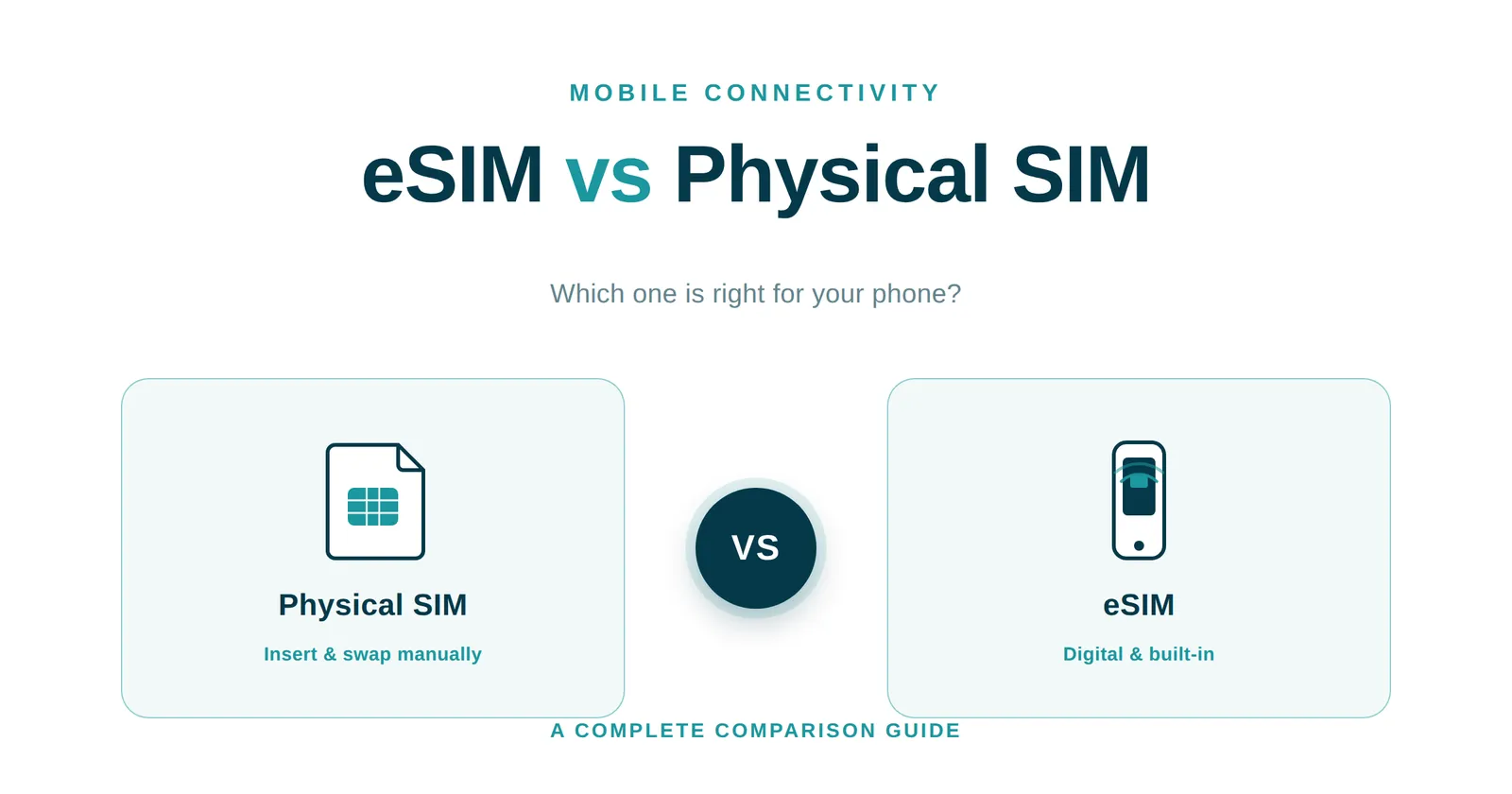
An eSIM is a chip built into your phone that stores your carrier's connection details digitally, while a physical SIM is a small removable card that does the same job. Both connect your phone to the same cell towers and carrier networks. The only real difference is how the carrier's information gets onto your phone.
With a physical SIM, you insert a small card, and moving to a new phone means physically moving that card too. With an eSIM, your carrier sends you a QR code or an activation profile, and you scan or install it directly onto the phone. The FCC's own consumer guide confirms most modern phones can actually hold both a physical SIM and one or more eSIM profiles at the same time, letting you run two active numbers, a personal line and a work line, or a local plan and a travel plan, without carrying two devices.
eSIM has been around since the iPhone XS in 2018, but it only became relevant to most buyers once Apple, Google, and Samsung started shipping some models without a physical SIM tray at all. That shift is happening fast: ABI Research forecasts more than 633 million eSIM-enabled devices will ship in 2026 alone, and Market.us reports total eSIM connections worldwide are on pace to hit 1.4 billion by the end of the year.
eSIM is fully supported in Pakistan today, but the carrier landscape behind it just changed in a big way. Jazz, Zong, and Ufone all offer eSIM activation, typically for a fee of around PKR 2,000 per profile, alongside their standard physical SIM options.
The bigger story is Telenor Pakistan. Developing Telecoms confirmed that as of July 1, 2026, Telenor Pakistan stopped existing as its own company, having fully merged into Pakistan Telecom Mobile Limited (PTML), the company behind Ufone. DAWN.com reported that the newly merged operator has since applied to Pakistan's telecom regulator for permission to rebrand under the global "e&" name, the same brand used by UAE-based Etisalat. That request has stirred real pushback: Business Recorder covered government concern over a major Pakistani telecom dropping "Pakistan" from its identity entirely. As of this writing, the rebrand is approved on paper but hasn't fully launched, so you'll likely still see the Ufone name for a while yet.
For anyone with an eSIM-capable phone, there's a technical step that catches people off guard. Every eSIM device has two IMEI numbers, one for the physical SIM slot and one for the eSIM, and PTA's own DIRBS FAQ confirms both numbers must show as "Compliant" in the DIRBS system before an eSIM profile will actually activate on a Pakistani network. If you're bringing in a phone from abroad, registering only one of the two IMEIs is a common mistake that leaves the eSIM side unusable.
This is worth double-checking specifically because it's easy to miss. You can dial the code to reveal both IMEIs on a dual-SIM-capable device, but many people only register the number printed on the box, which is usually just the physical SIM slot's IMEI. If you're planning to actually use the eSIM function in Pakistan, confirm both numbers separately through the DIRBS portal rather than assuming one registration covers the whole device.
Whether you get a choice between eSIM and physical SIM depends entirely on your exact phone model and the country it was sold in, not just the brand.
Apple is furthest along here. MacRumors confirmed the iPhone 17, 17 Pro, and 17 Pro Max ship as eSIM-only, with no physical SIM tray at all, in 12 markets: the US, Canada, Japan, Mexico, and several Gulf states among them. Pakistan isn't on that list, so iPhones sold locally still include a physical nano-SIM tray alongside eSIM support. The iPhone 17 Air is the exception that applies everywhere: it drops the SIM tray globally, no matter where you buy it.
This matters directly if you're importing a phone rather than buying one sold locally. A US-spec iPhone 17 bought abroad and brought into Pakistan will have no SIM tray at all, forcing you onto eSIM whether you want it or not, while the same model bought through official Pakistani channels keeps the physical slot.
Google Pixel followed a similar path, with the Pixel 10 going eSIM-only in the US specifically, while units sold in most other regions still include a physical SIM slot. Samsung has been more conservative so far, keeping a physical SIM slot on nearly every Galaxy model sold outside the US, including current flagships like the Galaxy S26 series.
The pattern to watch for going forward: eSIM-only starts in the US and a handful of other wealthy markets first, then gradually expands to more countries over time. It's worth checking the specific model and region before assuming any "new iPhone" or "new Pixel" automatically has a SIM tray, since the same phone name can mean two physically different devices depending on where it was sold.
Yes, in one specific and important way: an eSIM can't be physically removed or stolen, which closes off an entire category of fraud that physical SIM cards are vulnerable to.
Coruzant's breakdown explains that traditional SIM swap fraud often starts with a stolen or cloned physical card, something that simply isn't possible with a chip soldered into the phone itself. Since an eSIM profile also can't be pulled out and dropped into another device, a stolen eSIM-only phone is harder to resell for parts and easier to trace once it reconnects to a network.
That protection has real limits, though. Astound's security explainer points out that most SIM swap fraud doesn't actually involve stealing a physical card at all. It targets your carrier account directly, tricking customer support into transferring your number to a new SIM, physical or digital. An eSIM removes the physical theft angle, but it does nothing to stop someone who successfully convinces your carrier they're you. Real protection still comes down to strong account security with your carrier, like a PIN or extra verification step on your account, not just which type of SIM you use.
There's also a practical upside worth mentioning: a stolen phone with an eSIM is harder to strip for resale, since a thief can't simply pop the SIM out and drop the phone. That doesn't make the phone itself unstealable, but it does remove one of the easiest ways to make a stolen device untraceable.
Your eSIM doesn't automatically disappear when you factory reset your phone, and forgetting that before you sell it can leave your carrier account exposed to whoever buys it next.
iTechGuides explains that modern phones now ask whether you want to "keep eSIM and erase data" or wipe everything, including the eSIM profile, during a factory reset. If you're keeping the phone, choosing to keep the eSIM saves you from reactivating it later. If you're selling or giving the phone away, you need to actively choose full erasure, since leaving your eSIM active could let the next owner use your line before you've had it deactivated on your carrier's side.
Older phones running outdated software sometimes skip this choice entirely and wipe the eSIM automatically during any factory reset, so don't assume your specific device works the way a newer one does. Before you sell your phone, confirm your eSIM is fully removed and deactivated with your carrier, not just wiped from the phone's settings screen.
Buyers should treat this the same way they'd treat checking for a leftover Google or iCloud account lock. An eSIM profile that's technically wiped from the phone but never deactivated on the carrier's end can still leave the previous owner's line tied to that device in some systems, so a quick call or app check with the carrier after transferring ownership is worth the few extra minutes.
There's no universal right answer here, since the two options solve slightly different problems. It comes down to how you actually use your phone.
Pick eSIM if you regularly travel and want to add a local data plan without hunting down a physical SIM shop, you like keeping a personal and work number active on one phone, or the extra security against physical SIM theft matters to you. It also makes switching between carriers noticeably easier, similar to how easily you can hop between virtual network operators once activation happens entirely through an app instead of a physical card swap.
Pick a phone with a physical SIM slot if you often move your SIM between an old backup phone and a new one, you buy budget or older devices where eSIM support is inconsistent, or you'd rather troubleshoot connectivity issues the simple way, by just popping the card out and back in.
If you're not sure which category you fall into, a hybrid phone (one with both a physical tray and eSIM support) gives you the flexibility to decide later, without locking you into either approach today. Most current flagships sold in Pakistan still fall into this hybrid category, so for now, choosing eSIM over physical SIM locally is mostly a matter of preference rather than a hard requirement forced by your hardware.
Buying secondhand adds one more wrinkle worth thinking through. A used phone that was originally sold as eSIM-only in another country won't magically gain a SIM tray just because it's changed hands, so that limitation follows the device, not the original owner.
eSIM and physical SIM ultimately do the same job, but the choice is quietly narrowing as more phones, starting with flagship iPhones and Pixels in the US, drop the physical tray entirely. In Pakistan, both options remain fully supported by Jazz, Zong, and Ufone (soon possibly rebranded as e&), so the bigger risk is buying an imported, eSIM-only unit without realizing it has no physical SIM slot at all.
Before you buy your next phone, especially a used or imported one, confirm exactly which SIM type it supports rather than assuming based on the brand. If you're shopping for your next device, browse phones with the SIM setup you actually need, and if it's an iPhone you're after, it's worth taking a minute to compare current iPhone prices across models before you commit either way. And if you're upgrading rather than buying fresh, swapping your old phone safely is a better move than letting it sit unused once your new one is set up.
Does eSIM work in Pakistan? Yes. Jazz, Zong, and Ufone all support eSIM activation, typically for around PKR 2,000 per profile. Telenor Pakistan merged into PTML (Ufone's parent company) in July 2026 and may eventually rebrand as "e&," but eSIM support continues under the merged operator.
Which iPhones are eSIM-only? The iPhone 17 Air has no physical SIM tray anywhere in the world. The iPhone 17, 17 Pro, and 17 Pro Max are eSIM-only in 12 markets, including the US, Canada, and Japan, but keep a physical SIM tray in most other countries, including Pakistan.
Is eSIM safer than a physical SIM? Partly. An eSIM can't be physically stolen or swapped out of the phone, which blocks one common form of SIM swap fraud. It doesn't protect you from a fraudster who convinces your carrier's support team to transfer your number, since that attack targets your account, not the physical card.
What happens to my eSIM if I sell my phone? It doesn't automatically disappear during a factory reset on most modern phones, you usually get a choice to keep it or erase it. Before selling, choose full erasure and confirm the eSIM is deactivated with your carrier, not just removed from the phone's settings.
Should I get an eSIM or a physical SIM? Choose eSIM if you travel often, want two active numbers on one phone, or value the extra security against physical SIM theft. Choose a physical SIM if you frequently swap your SIM between devices or prefer simpler troubleshooting. A hybrid phone with both options avoids the decision entirely.
eSIM and physical SIM do the same job, connecting your phone to a carrier, but which one you actually have depends on your exact phone model, region, and carrier. This guide covers the real differences, whether eSIM works in Pakistan right now (including the Telenor-Ufone merger), which phones are eSIM-only, the security trade-offs, what happens to your eSIM when you sell your phone, and a straight answer on which one you should actually pick.
You unbox a "brand new" iPhone, pop out the SIM tool, and there's no SIM tray at all. That's not a defect. It's an eSIM-only phone, and depending on where you bought it, it might be the only kind of iPhone you can legally buy anymore.
eSIM and physical SIM cards do the exact same basic job: they tell a cell network who you are so it can connect your calls, texts, and data. The difference is entirely about form. A physical SIM is a small removable card. An eSIM is a chip built permanently into the phone, programmed with your carrier's details instead of swapped out by hand. Which one your phone actually has, and whether you get a choice, now depends heavily on the exact model, the country you bought it in, and your carrier. This guide covers what's actually different, whether eSIM works in Pakistan today, which phones no longer give you a choice, and how to decide which one is right for you.
An eSIM is a chip built into your phone that stores your carrier's connection details digitally, while a physical SIM is a small removable card that does the same job. Both connect your phone to the same cell towers and carrier networks. The only real difference is how the carrier's information gets onto your phone.
With a physical SIM, you insert a small card, and moving to a new phone means physically moving that card too. With an eSIM, your carrier sends you a QR code or an activation profile, and you scan or install it directly onto the phone. The FCC's own consumer guide confirms most modern phones can actually hold both a physical SIM and one or more eSIM profiles at the same time, letting you run two active numbers, a personal line and a work line, or a local plan and a travel plan, without carrying two devices.
eSIM has been around since the iPhone XS in 2018, but it only became relevant to most buyers once Apple, Google, and Samsung started shipping some models without a physical SIM tray at all. That shift is happening fast: ABI Research forecasts more than 633 million eSIM-enabled devices will ship in 2026 alone, and Market.us reports total eSIM connections worldwide are on pace to hit 1.4 billion by the end of the year.
eSIM is fully supported in Pakistan today, but the carrier landscape behind it just changed in a big way. Jazz, Zong, and Ufone all offer eSIM activation, typically for a fee of around PKR 2,000 per profile, alongside their standard physical SIM options.
The bigger story is Telenor Pakistan. Developing Telecoms confirmed that as of July 1, 2026, Telenor Pakistan stopped existing as its own company, having fully merged into Pakistan Telecom Mobile Limited (PTML), the company behind Ufone. DAWN.com reported that the newly merged operator has since applied to Pakistan's telecom regulator for permission to rebrand under the global "e&" name, the same brand used by UAE-based Etisalat. That request has stirred real pushback: Business Recorder covered government concern over a major Pakistani telecom dropping "Pakistan" from its identity entirely. As of this writing, the rebrand is approved on paper but hasn't fully launched, so you'll likely still see the Ufone name for a while yet.
For anyone with an eSIM-capable phone, there's a technical step that catches people off guard. Every eSIM device has two IMEI numbers, one for the physical SIM slot and one for the eSIM, and PTA's own DIRBS FAQ confirms both numbers must show as "Compliant" in the DIRBS system before an eSIM profile will actually activate on a Pakistani network. If you're bringing in a phone from abroad, registering only one of the two IMEIs is a common mistake that leaves the eSIM side unusable.
This is worth double-checking specifically because it's easy to miss. You can dial the code to reveal both IMEIs on a dual-SIM-capable device, but many people only register the number printed on the box, which is usually just the physical SIM slot's IMEI. If you're planning to actually use the eSIM function in Pakistan, confirm both numbers separately through the DIRBS portal rather than assuming one registration covers the whole device.
Whether you get a choice between eSIM and physical SIM depends entirely on your exact phone model and the country it was sold in, not just the brand.
Apple is furthest along here. MacRumors confirmed the iPhone 17, 17 Pro, and 17 Pro Max ship as eSIM-only, with no physical SIM tray at all, in 12 markets: the US, Canada, Japan, Mexico, and several Gulf states among them. Pakistan isn't on that list, so iPhones sold locally still include a physical nano-SIM tray alongside eSIM support. The iPhone 17 Air is the exception that applies everywhere: it drops the SIM tray globally, no matter where you buy it.
This matters directly if you're importing a phone rather than buying one sold locally. A US-spec iPhone 17 bought abroad and brought into Pakistan will have no SIM tray at all, forcing you onto eSIM whether you want it or not, while the same model bought through official Pakistani channels keeps the physical slot.
Google Pixel followed a similar path, with the Pixel 10 going eSIM-only in the US specifically, while units sold in most other regions still include a physical SIM slot. Samsung has been more conservative so far, keeping a physical SIM slot on nearly every Galaxy model sold outside the US, including current flagships like the Galaxy S26 series.
The pattern to watch for going forward: eSIM-only starts in the US and a handful of other wealthy markets first, then gradually expands to more countries over time. It's worth checking the specific model and region before assuming any "new iPhone" or "new Pixel" automatically has a SIM tray, since the same phone name can mean two physically different devices depending on where it was sold.
Yes, in one specific and important way: an eSIM can't be physically removed or stolen, which closes off an entire category of fraud that physical SIM cards are vulnerable to.
Coruzant's breakdown explains that traditional SIM swap fraud often starts with a stolen or cloned physical card, something that simply isn't possible with a chip soldered into the phone itself. Since an eSIM profile also can't be pulled out and dropped into another device, a stolen eSIM-only phone is harder to resell for parts and easier to trace once it reconnects to a network.
That protection has real limits, though. Astound's security explainer points out that most SIM swap fraud doesn't actually involve stealing a physical card at all. It targets your carrier account directly, tricking customer support into transferring your number to a new SIM, physical or digital. An eSIM removes the physical theft angle, but it does nothing to stop someone who successfully convinces your carrier they're you. Real protection still comes down to strong account security with your carrier, like a PIN or extra verification step on your account, not just which type of SIM you use.
There's also a practical upside worth mentioning: a stolen phone with an eSIM is harder to strip for resale, since a thief can't simply pop the SIM out and drop the phone. That doesn't make the phone itself unstealable, but it does remove one of the easiest ways to make a stolen device untraceable.
Your eSIM doesn't automatically disappear when you factory reset your phone, and forgetting that before you sell it can leave your carrier account exposed to whoever buys it next.
iTechGuides explains that modern phones now ask whether you want to "keep eSIM and erase data" or wipe everything, including the eSIM profile, during a factory reset. If you're keeping the phone, choosing to keep the eSIM saves you from reactivating it later. If you're selling or giving the phone away, you need to actively choose full erasure, since leaving your eSIM active could let the next owner use your line before you've had it deactivated on your carrier's side.
Older phones running outdated software sometimes skip this choice entirely and wipe the eSIM automatically during any factory reset, so don't assume your specific device works the way a newer one does. Before you sell your phone, confirm your eSIM is fully removed and deactivated with your carrier, not just wiped from the phone's settings screen.
Buyers should treat this the same way they'd treat checking for a leftover Google or iCloud account lock. An eSIM profile that's technically wiped from the phone but never deactivated on the carrier's end can still leave the previous owner's line tied to that device in some systems, so a quick call or app check with the carrier after transferring ownership is worth the few extra minutes.
There's no universal right answer here, since the two options solve slightly different problems. It comes down to how you actually use your phone.
Pick eSIM if you regularly travel and want to add a local data plan without hunting down a physical SIM shop, you like keeping a personal and work number active on one phone, or the extra security against physical SIM theft matters to you. It also makes switching between carriers noticeably easier, similar to how easily you can hop between virtual network operators once activation happens entirely through an app instead of a physical card swap.
Pick a phone with a physical SIM slot if you often move your SIM between an old backup phone and a new one, you buy budget or older devices where eSIM support is inconsistent, or you'd rather troubleshoot connectivity issues the simple way, by just popping the card out and back in.
If you're not sure which category you fall into, a hybrid phone (one with both a physical tray and eSIM support) gives you the flexibility to decide later, without locking you into either approach today. Most current flagships sold in Pakistan still fall into this hybrid category, so for now, choosing eSIM over physical SIM locally is mostly a matter of preference rather than a hard requirement forced by your hardware.
Buying secondhand adds one more wrinkle worth thinking through. A used phone that was originally sold as eSIM-only in another country won't magically gain a SIM tray just because it's changed hands, so that limitation follows the device, not the original owner.
eSIM and physical SIM ultimately do the same job, but the choice is quietly narrowing as more phones, starting with flagship iPhones and Pixels in the US, drop the physical tray entirely. In Pakistan, both options remain fully supported by Jazz, Zong, and Ufone (soon possibly rebranded as e&), so the bigger risk is buying an imported, eSIM-only unit without realizing it has no physical SIM slot at all.
Before you buy your next phone, especially a used or imported one, confirm exactly which SIM type it supports rather than assuming based on the brand. If you're shopping for your next device, browse phones with the SIM setup you actually need, and if it's an iPhone you're after, it's worth taking a minute to compare current iPhone prices across models before you commit either way. And if you're upgrading rather than buying fresh, swapping your old phone safely is a better move than letting it sit unused once your new one is set up.
Does eSIM work in Pakistan? Yes. Jazz, Zong, and Ufone all support eSIM activation, typically for around PKR 2,000 per profile. Telenor Pakistan merged into PTML (Ufone's parent company) in July 2026 and may eventually rebrand as "e&," but eSIM support continues under the merged operator.
Which iPhones are eSIM-only? The iPhone 17 Air has no physical SIM tray anywhere in the world. The iPhone 17, 17 Pro, and 17 Pro Max are eSIM-only in 12 markets, including the US, Canada, and Japan, but keep a physical SIM tray in most other countries, including Pakistan.
Is eSIM safer than a physical SIM? Partly. An eSIM can't be physically stolen or swapped out of the phone, which blocks one common form of SIM swap fraud. It doesn't protect you from a fraudster who convinces your carrier's support team to transfer your number, since that attack targets your account, not the physical card.
What happens to my eSIM if I sell my phone? It doesn't automatically disappear during a factory reset on most modern phones, you usually get a choice to keep it or erase it. Before selling, choose full erasure and confirm the eSIM is deactivated with your carrier, not just removed from the phone's settings.
Should I get an eSIM or a physical SIM? Choose eSIM if you travel often, want two active numbers on one phone, or value the extra security against physical SIM theft. Choose a physical SIM if you frequently swap your SIM between devices or prefer simpler troubleshooting. A hybrid phone with both options avoids the decision entirely.