Satellite messaging works differently on every phone and carrier. See which phones support it in 2026, what it costs, and where it falls short.
Satellite messaging works differently on every phone and carrier. See which phones support it in 2026, what it costs, and where it falls short.

iSwap.pk is Pakistan's marketplace for buying, selling, and swapping mobile phones. Our editorial team covers phone reviews, price guides, and buying tips to help you shop smarter. Learn more about us
Loading comments…
iSwap.pk is Pakistan's marketplace for buying, selling, and swapping mobile phones. Our editorial team covers phone reviews, price guides, and buying tips to help you shop smarter. Learn more about us
Loading comments…
Satellite messaging lets your phone send texts, and in an emergency, SOS alerts, with zero cell signal, by connecting straight to an orbiting satellite instead of a tower. Apple, Google Pixel, and Samsung all support it now, but the details (which carrier, what it costs, what actually works) vary a lot. This guide covers which phones support it in 2026, whether it's actually free, the real limitations, and what's coming next as new satellite deals expand coverage.
You're on a hiking trail with zero bars, and your phone still finds a way to send help your exact location. That's not a glitch. It's satellite messaging, and it's now built into most flagship phones sold in 2026, though almost nobody understands the fine print until they actually need it.
The confusing part is that "satellite messaging" isn't one single feature. Apple, Google, Samsung, and T-Mobile all run different versions of it, built on different satellite networks, with different prices and different limits. Some of it is free forever. Some of it costs a monthly fee. Some of it only works for 911-style emergencies, not regular texting. This guide sorts out which phones actually support satellite messaging right now, what it really costs, where it falls short, and where the technology is headed next.
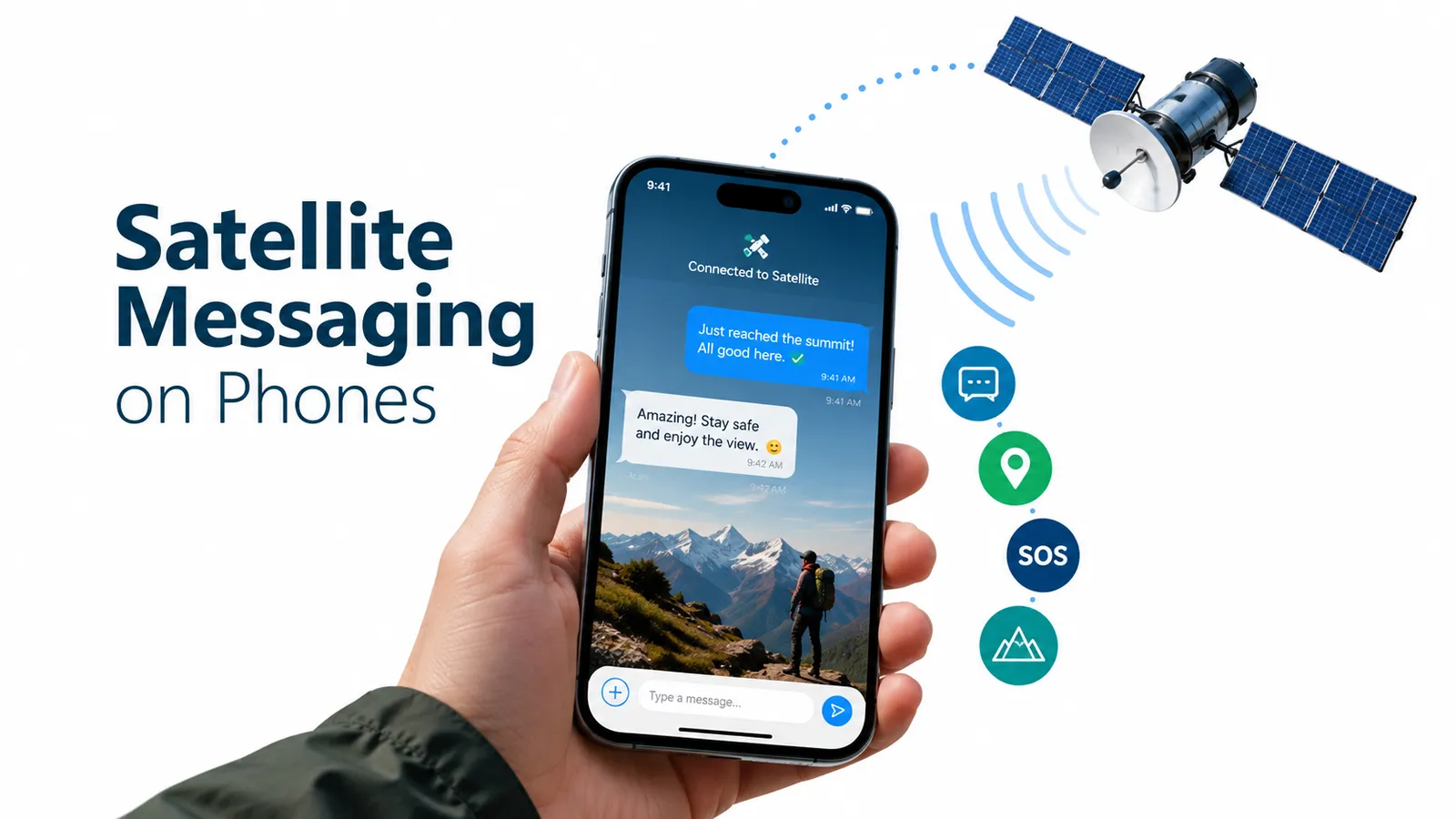
Satellite messaging lets your phone send texts, and in emergencies, distress alerts, by connecting directly to an orbiting satellite instead of a cell tower. It works when you have zero bars, as long as you have a clear view of the sky. Apple, Google, and Samsung all build this into recent phones, though the company actually running the satellite network differs by brand and carrier.
Apple's own support page confirms this isn't one unified system. Apple's features run on Globalstar's satellites. Google Pixel's satellite features run on a company called Skylo. T-Mobile's version, called T-Satellite, runs on SpaceX's Starlink satellites. They all solve the same basic problem (no towers, no signal, still connected), but they're three separate technical systems wearing similar marketing names.
That's why your phone can text over satellite while your friend's identical-looking Android a few feet away can't, even with no cell signal for either of you. It comes down to which satellite network your specific phone and carrier combination was actually built to talk to.
There are really two different features hiding under the "satellite messaging" label, and mixing them up leads to a lot of confusion about what your phone can actually do.
Satellite SOS (Apple's Emergency SOS via satellite is the best-known version) is built purely for emergencies. It walks you through a short questionnaire, shares your location with responders, and relays short, structured messages to emergency services. It's available on every supported phone at no cost, since carriers and manufacturers treat it as a safety feature rather than a product to charge for.
Full satellite messaging is different: real, two-way texting to any contact in your phone, not just emergency services. Apple's Messages via satellite lets you text friends and family the same way, and Android phones offer similar functionality through Google Messages or their carrier's own app. This version is where pricing and carrier restrictions start to matter, since it's a full communication feature, not just a safety net.
The practical difference shows up the moment you actually need either one. Emergency SOS walks you through a guided flow (what's the emergency, are you injured, do you need police, fire, or medical help) and sends a compact, structured report to responders, since every character sent over satellite is precious bandwidth. Full messaging works more like a normal conversation, just slower and more limited, which is exactly why it's the version some carriers choose to charge for.
Support breaks down almost entirely by brand and carrier, not by phone price or release year alone. Here's where things actually stand in 2026.
Apple: Every iPhone from the iPhone 14 onward supports Emergency SOS via satellite, Find My via satellite, Roadside Assistance, and Messages via satellite, all running on Globalstar's network. Roadside Assistance is a genuinely underrated one here: it connects you directly to a provider like AAA over satellite, letting you pick from options like a flat tire, a lockout, or an empty tank, even somewhere with zero cell coverage at all.
Google Pixel: Techlicious confirms the Pixel 9, 9 Pro, 9 Pro XL, and 9 Pro Fold have satellite SOS built in through Skylo, independent of your carrier. The Pixel 9a is the one exception without satellite hardware. Every Pixel 10 model, including the budget 10a, supports it.
Samsung Galaxy: Coverage depends heavily on your carrier here. Samsung's own newsroom confirms Galaxy S21 and newer, plus select A series models, support satellite messaging through T-Mobile's network. On Verizon, only the Galaxy S25 series and later, plus the Galaxy Z Fold7 and Z Flip7, get satellite access, and GSMArena confirmed in January 2026 that the entire Galaxy S26 lineup received FCC certification for satellite communication too.
Motorola: Recent Razr, Edge, and Moto G models from 2024 onward support satellite texting, again through T-Mobile's network rather than a Motorola-built system.
The pattern worth remembering: Pixel is the only Android line where satellite support comes baked into the phone itself, independent of carrier. Every other Android brand depends on which network you're actually subscribed to.
If you're not sure whether your own phone qualifies, don't guess based on the brand alone. On iPhone, check Settings, then Cellular, and look for a satellite option. On most Android phones, check Settings, then Safety and Emergency, and look for "Satellite SOS" or a similar option. If it's not listed at all, your specific model or carrier combination doesn't support it yet, regardless of how new or expensive the phone is.
It depends entirely on your phone and carrier, and the answer ranges from completely free to a paid monthly add-on. There's no single industry-standard price, which is exactly why this trips people up.
PhoneArena confirmed Verizon's satellite messaging through Skylo is free for eligible customers on a supported Galaxy phone, no add-on fee required. Skylo's own announcement confirms the same deal covers basic texting, not just emergency alerts. Google Pixel's satellite features are also free, no subscription needed.
T-Mobile's T-Satellite works differently. SatelliteInternet.com's pricing breakdown puts it at roughly $10 a month as a standalone add-on, though it's included at no extra cost on T-Mobile's higher-tier unlimited plans. If you're on a basic T-Mobile plan and want satellite texting, expect that monthly charge on top of your regular bill. Apple's satellite features have historically shipped with a free introductory period tied to when you activate the phone, so check your specific plan's terms rather than assuming it stays free indefinitely.
Satellite messaging is genuinely useful, but it's nowhere near as capable as a normal cell connection, and the gap catches a lot of people off guard. Verizon's own support page lays out the restrictions clearly.
You can only send plain text, generally capped well under 500 characters per message. Photos, videos, voice messages, typing indicators, and read receipts don't work at all, and neither do MMS or RCS messages. Every message has to be short, plain text, one at a time.
You also need a genuinely clear view of the sky. Standing indoors, under thick tree cover, in a narrow city street between tall buildings, or under heavy cloud cover can all prevent your phone from finding a satellite at all. When it does connect, sending a message can take noticeably longer than a normal text, sometimes a minute or more, since your phone has to track a moving satellite across the sky while it transmits.
Battery drain is another honest trade-off. Real-world testing from Outdoor Life found that actively holding a satellite connection alongside normal phone use, like maps or photos, drained the battery noticeably faster than a dedicated satellite messenger device built just for that job. A phone already low on battery in a dead zone has less runway than you might expect for a back-and-forth conversation.
Coverage is also geographically limited. Most services currently work across the US and Canada, with growing support in parts of Europe, Australia, New Zealand, and Japan, but plenty of the world still has no satellite texting coverage at all.
None of this makes satellite messaging useless, but it does mean you should think of it as a backup for genuine dead zones, not a replacement for a real signal. It's built to get one short, critical message out when nothing else works, not to replace your normal texting habits.
Once you dig past the marketing names, three separate companies are actually running the satellites behind all of this, and knowing which one your phone uses explains most of the confusion.
Globalstar powers Apple's satellite features exclusively, across every supported iPhone. Skylo is the interesting one: it powers both Verizon's satellite messaging on Galaxy phones and Google Pixel's built-in satellite SOS, meaning two competing companies use the exact same satellite backend for their customers. T-Satellite, T-Mobile's brand name, actually runs on SpaceX's Starlink satellites, the same constellation known for home internet service.
There's now a fourth wrinkle worth knowing about. SpaceX rebranded its underlying direct-to-cell service as Starlink Mobile in early 2026, opening it up beyond just T-Mobile customers through additional carrier partners. That means the Starlink satellites behind T-Satellite are starting to show up under other brand names too, the exact same pattern already playing out with MVNOs reselling access to the same three big cell networks.
This is the same host-network confusion that shows up everywhere in mobile tech. It's a lot like how MVNOs lease network capacity from a host carrier instead of building their own towers: the brand name you see on your phone often isn't the company actually doing the technical work behind it. It's also similar to how T-Mobile brands its fastest 5G tier as "5G UC" while Verizon calls its equivalent something else entirely. Different company names, similar underlying idea, and no consistent labeling across the industry.
This technology is still moving fast, and a few 2026 developments are worth watching if you're deciding whether to care about satellite messaging at all.
The biggest shift is a business deal, not a new feature: Amazon announced plans to acquire Globalstar, the company powering all of Apple's satellite features. Once that deal closes, expected in 2027, Apple's satellite network will gradually shift onto Amazon's own Leo satellite constellation instead. Existing features shouldn't disappear, but the infrastructure behind them is about to change hands.
The market itself is expanding fast too. Fortune Business Insights values the direct satellite-to-phone market at roughly $5 billion in 2026, projected to reach $17.62 billion by 2030, a 37 percent annual growth rate. Industry tracking from ResearchAndMarkets also notes that T-Mobile and SpaceX had already signed up more than 3 million direct-to-cell subscribers by early 2026, proof that demand for this feature is real, not just a marketing gimmick.
Expect more phones, not fewer, to ship with satellite hardware built in by default over the next couple of years, and expect the current patchwork of free-here, paid-there pricing to keep shifting as carriers compete for attention on this feature. The long-term goal every network is chasing is the same one: a phone that never truly loses connection, no matter how far you are from the nearest tower.
Satellite messaging genuinely works, but it means something different depending on your phone, carrier, and which of the three networks (Globalstar, Skylo, or Starlink-based T-Satellite) you're actually connected to. Emergency SOS is free everywhere it's supported, but full two-way texting can mean anything from free to a monthly add-on. Treat it as a genuine safety net for dead zones, not a feature to base your entire phone purchase around, since even the best satellite connection is still slower and far more limited than an ordinary bar of signal.
Before you assume a phone has this feature, or that it'll work the way a friend's does, check what to look for on a used phone, since satellite support depends on the exact model and carrier lock, not just the brand name. If you want a phone built for this from the start, shop satellite-ready phones rather than guessing, and if you're upgrading, swapping your old phone safely is a better move than letting it collect dust in a drawer.
Does my phone have satellite messaging? It depends on the exact model. Every iPhone 14 and later supports it, as do Google Pixel 9 (except the 9a) and all Pixel 10 models. Samsung Galaxy support depends on your carrier: T-Mobile covers Galaxy S21 and newer, while Verizon only covers the Galaxy S25 series and later.
Is satellite messaging free? It varies by carrier. Verizon's Skylo-based satellite messaging and Google Pixel's satellite features are both free with no add-on fee. T-Mobile's T-Satellite is typically a paid add-on unless you're on one of its higher-tier unlimited plans, which include it at no extra cost.
What's the difference between T-Satellite and Skylo? They're different companies running different satellites. T-Satellite is T-Mobile's brand name for a system built on SpaceX's Starlink satellites. Skylo is a separate satellite company that powers both Verizon's satellite messaging and Google Pixel's built-in satellite SOS.
Can I send photos over satellite messaging? No. Satellite messaging only supports short, plain text messages. Photos, videos, voice messages, and MMS or RCS messages aren't supported on any current satellite messaging service.
Does satellite messaging work indoors? No. You need a genuinely clear view of the sky for your phone to connect to a satellite. Being indoors, under thick tree cover, between tall buildings, or under heavy cloud cover can all prevent the connection from working at all.
Satellite messaging lets your phone send texts, and in an emergency, SOS alerts, with zero cell signal, by connecting straight to an orbiting satellite instead of a tower. Apple, Google Pixel, and Samsung all support it now, but the details (which carrier, what it costs, what actually works) vary a lot. This guide covers which phones support it in 2026, whether it's actually free, the real limitations, and what's coming next as new satellite deals expand coverage.
You're on a hiking trail with zero bars, and your phone still finds a way to send help your exact location. That's not a glitch. It's satellite messaging, and it's now built into most flagship phones sold in 2026, though almost nobody understands the fine print until they actually need it.
The confusing part is that "satellite messaging" isn't one single feature. Apple, Google, Samsung, and T-Mobile all run different versions of it, built on different satellite networks, with different prices and different limits. Some of it is free forever. Some of it costs a monthly fee. Some of it only works for 911-style emergencies, not regular texting. This guide sorts out which phones actually support satellite messaging right now, what it really costs, where it falls short, and where the technology is headed next.
Satellite messaging lets your phone send texts, and in emergencies, distress alerts, by connecting directly to an orbiting satellite instead of a cell tower. It works when you have zero bars, as long as you have a clear view of the sky. Apple, Google, and Samsung all build this into recent phones, though the company actually running the satellite network differs by brand and carrier.
Apple's own support page confirms this isn't one unified system. Apple's features run on Globalstar's satellites. Google Pixel's satellite features run on a company called Skylo. T-Mobile's version, called T-Satellite, runs on SpaceX's Starlink satellites. They all solve the same basic problem (no towers, no signal, still connected), but they're three separate technical systems wearing similar marketing names.
That's why your phone can text over satellite while your friend's identical-looking Android a few feet away can't, even with no cell signal for either of you. It comes down to which satellite network your specific phone and carrier combination was actually built to talk to.
There are really two different features hiding under the "satellite messaging" label, and mixing them up leads to a lot of confusion about what your phone can actually do.
Satellite SOS (Apple's Emergency SOS via satellite is the best-known version) is built purely for emergencies. It walks you through a short questionnaire, shares your location with responders, and relays short, structured messages to emergency services. It's available on every supported phone at no cost, since carriers and manufacturers treat it as a safety feature rather than a product to charge for.
Full satellite messaging is different: real, two-way texting to any contact in your phone, not just emergency services. Apple's Messages via satellite lets you text friends and family the same way, and Android phones offer similar functionality through Google Messages or their carrier's own app. This version is where pricing and carrier restrictions start to matter, since it's a full communication feature, not just a safety net.
The practical difference shows up the moment you actually need either one. Emergency SOS walks you through a guided flow (what's the emergency, are you injured, do you need police, fire, or medical help) and sends a compact, structured report to responders, since every character sent over satellite is precious bandwidth. Full messaging works more like a normal conversation, just slower and more limited, which is exactly why it's the version some carriers choose to charge for.
Support breaks down almost entirely by brand and carrier, not by phone price or release year alone. Here's where things actually stand in 2026.
Apple: Every iPhone from the iPhone 14 onward supports Emergency SOS via satellite, Find My via satellite, Roadside Assistance, and Messages via satellite, all running on Globalstar's network. Roadside Assistance is a genuinely underrated one here: it connects you directly to a provider like AAA over satellite, letting you pick from options like a flat tire, a lockout, or an empty tank, even somewhere with zero cell coverage at all.
Google Pixel: Techlicious confirms the Pixel 9, 9 Pro, 9 Pro XL, and 9 Pro Fold have satellite SOS built in through Skylo, independent of your carrier. The Pixel 9a is the one exception without satellite hardware. Every Pixel 10 model, including the budget 10a, supports it.
Samsung Galaxy: Coverage depends heavily on your carrier here. Samsung's own newsroom confirms Galaxy S21 and newer, plus select A series models, support satellite messaging through T-Mobile's network. On Verizon, only the Galaxy S25 series and later, plus the Galaxy Z Fold7 and Z Flip7, get satellite access, and GSMArena confirmed in January 2026 that the entire Galaxy S26 lineup received FCC certification for satellite communication too.
Motorola: Recent Razr, Edge, and Moto G models from 2024 onward support satellite texting, again through T-Mobile's network rather than a Motorola-built system.
The pattern worth remembering: Pixel is the only Android line where satellite support comes baked into the phone itself, independent of carrier. Every other Android brand depends on which network you're actually subscribed to.
If you're not sure whether your own phone qualifies, don't guess based on the brand alone. On iPhone, check Settings, then Cellular, and look for a satellite option. On most Android phones, check Settings, then Safety and Emergency, and look for "Satellite SOS" or a similar option. If it's not listed at all, your specific model or carrier combination doesn't support it yet, regardless of how new or expensive the phone is.
It depends entirely on your phone and carrier, and the answer ranges from completely free to a paid monthly add-on. There's no single industry-standard price, which is exactly why this trips people up.
PhoneArena confirmed Verizon's satellite messaging through Skylo is free for eligible customers on a supported Galaxy phone, no add-on fee required. Skylo's own announcement confirms the same deal covers basic texting, not just emergency alerts. Google Pixel's satellite features are also free, no subscription needed.
T-Mobile's T-Satellite works differently. SatelliteInternet.com's pricing breakdown puts it at roughly $10 a month as a standalone add-on, though it's included at no extra cost on T-Mobile's higher-tier unlimited plans. If you're on a basic T-Mobile plan and want satellite texting, expect that monthly charge on top of your regular bill. Apple's satellite features have historically shipped with a free introductory period tied to when you activate the phone, so check your specific plan's terms rather than assuming it stays free indefinitely.
Satellite messaging is genuinely useful, but it's nowhere near as capable as a normal cell connection, and the gap catches a lot of people off guard. Verizon's own support page lays out the restrictions clearly.
You can only send plain text, generally capped well under 500 characters per message. Photos, videos, voice messages, typing indicators, and read receipts don't work at all, and neither do MMS or RCS messages. Every message has to be short, plain text, one at a time.
You also need a genuinely clear view of the sky. Standing indoors, under thick tree cover, in a narrow city street between tall buildings, or under heavy cloud cover can all prevent your phone from finding a satellite at all. When it does connect, sending a message can take noticeably longer than a normal text, sometimes a minute or more, since your phone has to track a moving satellite across the sky while it transmits.
Battery drain is another honest trade-off. Real-world testing from Outdoor Life found that actively holding a satellite connection alongside normal phone use, like maps or photos, drained the battery noticeably faster than a dedicated satellite messenger device built just for that job. A phone already low on battery in a dead zone has less runway than you might expect for a back-and-forth conversation.
Coverage is also geographically limited. Most services currently work across the US and Canada, with growing support in parts of Europe, Australia, New Zealand, and Japan, but plenty of the world still has no satellite texting coverage at all.
None of this makes satellite messaging useless, but it does mean you should think of it as a backup for genuine dead zones, not a replacement for a real signal. It's built to get one short, critical message out when nothing else works, not to replace your normal texting habits.
Once you dig past the marketing names, three separate companies are actually running the satellites behind all of this, and knowing which one your phone uses explains most of the confusion.
Globalstar powers Apple's satellite features exclusively, across every supported iPhone. Skylo is the interesting one: it powers both Verizon's satellite messaging on Galaxy phones and Google Pixel's built-in satellite SOS, meaning two competing companies use the exact same satellite backend for their customers. T-Satellite, T-Mobile's brand name, actually runs on SpaceX's Starlink satellites, the same constellation known for home internet service.
There's now a fourth wrinkle worth knowing about. SpaceX rebranded its underlying direct-to-cell service as Starlink Mobile in early 2026, opening it up beyond just T-Mobile customers through additional carrier partners. That means the Starlink satellites behind T-Satellite are starting to show up under other brand names too, the exact same pattern already playing out with MVNOs reselling access to the same three big cell networks.
This is the same host-network confusion that shows up everywhere in mobile tech. It's a lot like how MVNOs lease network capacity from a host carrier instead of building their own towers: the brand name you see on your phone often isn't the company actually doing the technical work behind it. It's also similar to how T-Mobile brands its fastest 5G tier as "5G UC" while Verizon calls its equivalent something else entirely. Different company names, similar underlying idea, and no consistent labeling across the industry.
This technology is still moving fast, and a few 2026 developments are worth watching if you're deciding whether to care about satellite messaging at all.
The biggest shift is a business deal, not a new feature: Amazon announced plans to acquire Globalstar, the company powering all of Apple's satellite features. Once that deal closes, expected in 2027, Apple's satellite network will gradually shift onto Amazon's own Leo satellite constellation instead. Existing features shouldn't disappear, but the infrastructure behind them is about to change hands.
The market itself is expanding fast too. Fortune Business Insights values the direct satellite-to-phone market at roughly $5 billion in 2026, projected to reach $17.62 billion by 2030, a 37 percent annual growth rate. Industry tracking from ResearchAndMarkets also notes that T-Mobile and SpaceX had already signed up more than 3 million direct-to-cell subscribers by early 2026, proof that demand for this feature is real, not just a marketing gimmick.
Expect more phones, not fewer, to ship with satellite hardware built in by default over the next couple of years, and expect the current patchwork of free-here, paid-there pricing to keep shifting as carriers compete for attention on this feature. The long-term goal every network is chasing is the same one: a phone that never truly loses connection, no matter how far you are from the nearest tower.
Satellite messaging genuinely works, but it means something different depending on your phone, carrier, and which of the three networks (Globalstar, Skylo, or Starlink-based T-Satellite) you're actually connected to. Emergency SOS is free everywhere it's supported, but full two-way texting can mean anything from free to a monthly add-on. Treat it as a genuine safety net for dead zones, not a feature to base your entire phone purchase around, since even the best satellite connection is still slower and far more limited than an ordinary bar of signal.
Before you assume a phone has this feature, or that it'll work the way a friend's does, check what to look for on a used phone, since satellite support depends on the exact model and carrier lock, not just the brand name. If you want a phone built for this from the start, shop satellite-ready phones rather than guessing, and if you're upgrading, swapping your old phone safely is a better move than letting it collect dust in a drawer.
Does my phone have satellite messaging? It depends on the exact model. Every iPhone 14 and later supports it, as do Google Pixel 9 (except the 9a) and all Pixel 10 models. Samsung Galaxy support depends on your carrier: T-Mobile covers Galaxy S21 and newer, while Verizon only covers the Galaxy S25 series and later.
Is satellite messaging free? It varies by carrier. Verizon's Skylo-based satellite messaging and Google Pixel's satellite features are both free with no add-on fee. T-Mobile's T-Satellite is typically a paid add-on unless you're on one of its higher-tier unlimited plans, which include it at no extra cost.
What's the difference between T-Satellite and Skylo? They're different companies running different satellites. T-Satellite is T-Mobile's brand name for a system built on SpaceX's Starlink satellites. Skylo is a separate satellite company that powers both Verizon's satellite messaging and Google Pixel's built-in satellite SOS.
Can I send photos over satellite messaging? No. Satellite messaging only supports short, plain text messages. Photos, videos, voice messages, and MMS or RCS messages aren't supported on any current satellite messaging service.
Does satellite messaging work indoors? No. You need a genuinely clear view of the sky for your phone to connect to a satellite. Being indoors, under thick tree cover, between tall buildings, or under heavy cloud cover can all prevent the connection from working at all.